
News / Blog
How to Choose an Industrial Nylon Cable Fixing Gland
Selecting the right Industrial Nylon Cable Fixing Gland is a small decision with significant consequences. In a control cabinet, one loose gland can expose cables to dust, moisture, vibration, and mechanical strain. The result may include insulation damage, unstable signals, or unexpected maintenance costs.
Industry demand supports careful selection. Grand View Research has reported continued growth in industrial automation, driven by smart factories, connected machinery, and distributed control systems. These environments require reliable cable entry protection. MarketsandMarkets has also identified rising Industrial Ethernet adoption as a major trend, increasing the need for organized and protected cable routing. However, market growth does not make every nylon gland suitable. One detail is easy to miss.
A practical evaluation should examine thread type, cable diameter range, sealing performance, operating temperature, flame behavior, and resistance to oils or chemicals. IEC 62444 provides guidance for cable glands, while IEC 60529 defines enclosure protection ratings such as IP65, IP66, and IP68. These ratings should be verified against the manufacturer’s test documentation, not assumed from product images. In field installations, installers should check whether the gland compresses the cable evenly without crushing its jacket. They should also confirm compatibility with the enclosure material and installation tools.
Nylon offers low weight, corrosion resistance, and efficient installation. It may not suit every high-temperature or severe-impact application. That limitation matters. This guide explains how to compare specifications, interpret technical reports, and choose an Industrial Nylon Cable Fixing Gland that matches real operating conditions. A careful choice protects more than the cable.
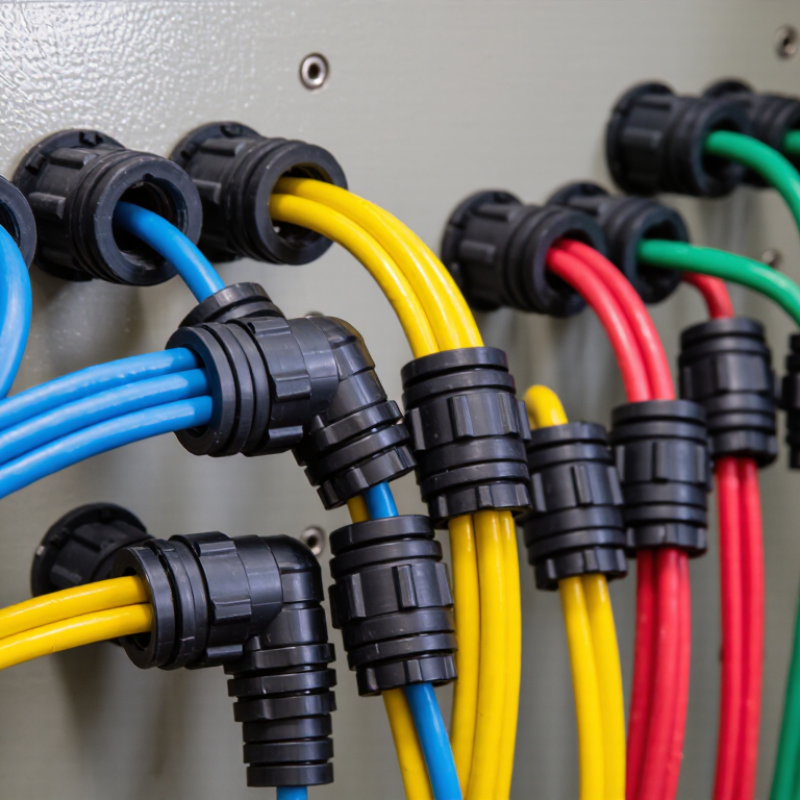
Define the Requirements for an Industrial Nylon Cable Fixing Gland
Choosing an industrial nylon cable fixing gland begins with a clear requirement sheet. Record the cable’s outer diameter, construction, bend radius, and entry location. Measure twice. A few millimeters can affect sealing and strain relief.
Select a gland size that matches the measured cable range, not a rough estimate. Define the mounting thread, panel thickness, and available installation space. Metric and other thread forms are not automatically interchangeable. Check the required ingress protection level, especially near washdown areas, dust, or outdoor equipment. Nylon can perform well, but temperature, ultraviolet exposure, oils, solvents, and vibration may change its suitability. Specify the operating temperature range with actual site conditions, including heat from nearby equipment. Do not rely only on typical values.
The cable’s movement also matters. A flexible machine cable may need stronger strain control than a fixed control cable. Consider whether the gland must resist pulling, twisting, or repeated bending. Confirm compatibility with the enclosure material and the sealing washer. During installation, follow the stated torque range and inspect the seal after tightening. Over-tightening can deform parts; under-tightening can allow moisture inside. Small omissions matter. In field inspections, unclear cable diameters often cause avoidable rework. A practical specification should include photographs, thread details, environmental exposure, and the installer’s access limits. Leave enough clearance for a wrench and future cable maintenance.
How to Choose an Industrial Nylon Cable Fixing Gland - Define the Requirements for an Industrial Nylon Cable Fixing Gland
Use the following requirement matrix to match the cable, enclosure, environment, and installation method with a suitable industrial nylon cable fixing gland.
| Requirement | Recommended Specification | Typical Data or Selection Range | Why It Matters | Selection Check |
|---|---|---|---|---|
| Cable outer diameter | Select a gland whose clamping range covers the measured cable diameter. | M12: approximately 3–6.5 mm M16: approximately 4–8 mm M20: approximately 6–12 mm M25: approximately 13–18 mm | The cable must be firmly sealed without excessive compression or damage to the jacket. | Measure the actual cable outside diameter, including any jacket variation. |
| Thread size | Match the gland thread to the enclosure entry or locknut. | Common: M12, M16, M20, M25, M32 Metric coarse pitch is commonly 1.5 mm for sizes M16 and larger. | An incorrect thread can cause poor mechanical retention, leakage, or cross-threading. | Confirm metric or another thread system before ordering. |
| Ingress protection | Choose a sealed design with a suitable elastomer sealing ring and cable seal. | Typical industrial nylon glands: IP65 to IP68, depending on design and installation. | Higher IP protection helps prevent dust and water ingress into the enclosure. | Verify the exact IP rating for the complete assembly, including the enclosure and locknut. |
| Material | Use UV-stabilized polyamide 6 or polyamide 66 for general industrial applications. | Typical body material: PA6 or PA66 Typical seal material: EPDM, NBR, or equivalent elastomer | Material selection affects impact resistance, chemical compatibility, weatherability, and service life. | Choose UV-resistant material for outdoor or sun-exposed installations. |
| Operating temperature | Select a gland rated for both the minimum and maximum application temperature. | Common nylon gland ranges are approximately −40°C to +100°C, depending on the material and seal. | Temperature outside the rated range may cause brittleness, deformation, or loss of sealing pressure. | Consider ambient temperature, cable temperature, and heat from nearby equipment. |
| Cable type | Match the gland to unarmored, flexible, multicore, control, or instrumentation cable. | Nylon glands are generally used with non-armored cables and cables requiring strain relief. | The cable construction determines the required clamping method and mechanical support. | For armored or metal-braid cables, use a gland specifically designed for armor termination. |
| Strain relief | Use a compression-style gland that grips the cable jacket evenly around its circumference. | Choose a design with a suitable clamping insert and sufficient cable retention. | Strain relief prevents pulling, twisting, and vibration from transferring to terminals or connectors. | Check the cable retention requirement and installation torque in the technical data. |
| Impact resistance | Select a robust polyamide construction for equipment exposed to handling or vibration. | Many industrial nylon glands are specified with an impact category such as IK08, depending on construction. | Impact resistance reduces the risk of cracking during installation, transport, or operation. | Confirm the impact rating when the enclosure is installed in exposed locations. |
| Flammability | Choose a gland body made from flame-retardant engineering plastic where required. | Some nylon materials are available with UL 94 V-2 or higher flammability classifications. | Flammability performance can support enclosure safety requirements in electrical equipment. | Check the required classification against the applicable equipment standard. |
| Outdoor exposure | Use UV-stabilized nylon and a weather-resistant sealing compound. | Black UV-stabilized polyamide is commonly selected for outdoor cable entry applications. | UV exposure can reduce strength and cause discoloration or cracking in unsuitable plastics. | Confirm outdoor suitability, UV resistance, and the expected service life. |
| Chemical environment | Check compatibility with oils, detergents, solvents, coolants, and cleaning agents. | PA6 or PA66 is suitable for many general industrial environments, but compatibility is chemical-specific. | Chemicals may swell, soften, embrittle, or degrade the gland body and seal. | Review the chemical safety data and obtain a compatibility confirmation when necessary. |
| Panel thickness and thread length | Choose a thread length that passes through the enclosure wall and allows full locknut engagement. | Common thread lengths are approximately 8–15 mm, depending on gland size and design. | Insufficient thread engagement can weaken mounting and compromise the seal. | Measure the enclosure wall, coating, gasket, and any internal clearance. |
| Installation space | Allow room for tightening, cable bending, and maintenance access. | Use a compact straight gland where clearance is limited; use an angled gland only when required by routing. | Restricted space can create excessive cable bending and make correct tightening difficult. | Follow the cable manufacturer’s minimum bend radius. |
| Sealing method | Use a compression seal suited to the cable jacket material and diameter. | Sealing elements are commonly made from EPDM, NBR, or other application-specific elastomers. | The seal provides the primary barrier against dust, moisture, and contaminants. | Confirm seal compatibility and avoid selecting a range that is too wide for the cable. |
| Compliance and testing | Specify the required standards, test reports, and documentation before purchase. | Common references may include IEC 62444 for cable glands and IEC 60529 for IP ratings. | Documented testing helps demonstrate that the gland is suitable for the intended installation. | Request dimensional drawings, torque data, material details, and test documentation. |
| Installation torque | Follow the manufacturer’s specified body, locknut, and cap tightening torque. | Torque values vary with thread size, material, seal design, and cable diameter. | Under-tightening can cause leakage; over-tightening can damage the cable or gland. | Use a calibrated torque tool when consistent sealing is required. |