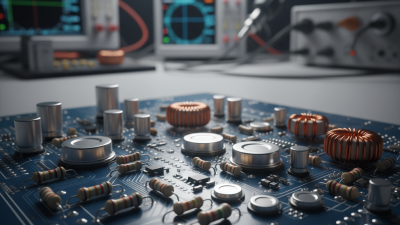
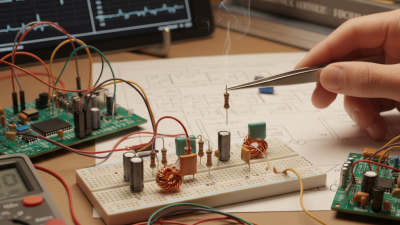
What is Passive Electronic Components and Their Applications?
Passive electronic components play a vital role in modern electronics. They are crucial for circuit function and performance. Unlike active components, they do not provide amplification or power gain. Instead, they store or dissipate energy.
Common types include resistors, capacitors, and inductors. Each component has a unique function. For example, resistors limit current flow. Capacitors store electrical energy for later use. Inductors can store energy in a magnetic field. Their applications are vast, ranging from consumer electronics to industrial devices.
Despite their importance, passive electronic components can sometimes be overlooked in design processes. Engineers must consider their characteristics carefully. The wrong value or type can lead to circuit failure. Understanding these components is essential for optimal performance.
Definition and Characteristics of Passive Electronic Components
Passive electronic components play a vital role in various electronic circuits. These components do not require power to operate. They are essential for storing, filtering, and dissipating energy. Common types include resistors, capacitors, and inductors. Each of these components has unique characteristics that define their functions.
Resistors limit current flow. They convert electrical energy into heat. Capacitors store and release energy quickly. Inductors, on the other hand, store energy in a magnetic field. Understanding these characteristics is crucial for designing effective circuits.
**Tips:** When working with passive components, always consider their ratings. Overloading can lead to failure. Proper application ensures reliability. Be mindful of tolerances, as the actual values can vary. This variability can impact performance. Take time to analyze the circuit requirements. It can prevent costly mistakes.
What is Passive Electronic Components and Their Applications?
| Component Type |
Definition |
Characteristics |
Applications |
| Resistor |
A component that resists the flow of electric current. |
Fixed or variable resistance values, power rating. |
Voltage dividers, current limiting, biasing components. |
| Capacitor |
A device that stores electrical energy in an electric field. |
Capacitance value, voltage rating, leakage current. |
Filtering, coupling, timing applications. |
| Inductor |
A passive component that stores energy in a magnetic field. |
Inductance value, current rating, DC resistance. |
Energy storage, filtering, and in signal processing. |
| Transformer |
A device that transfers electrical energy between circuits. |
Turns ratio, voltage levels, efficiency. |
Voltage conversion, isolation, impedance matching. |
| Diode (Zener) |
A semiconductor device that allows current to flow in one direction. |
Voltage regulation, reverse breakdown characteristics. |
Voltage stabilization in power supplies. |
Types of Passive Electronic Components and Their Functions
Passive electronic components play a vital role in circuits. They do not require external power to operate. Common types include resistors, capacitors, and inductors. Each type serves a distinct function, crucial for circuit performance.
Resistors limit current flow. They are essential for controlling voltage levels. Capacitors store and release energy, pivotal for filtering applications. Inductors, on the other hand, store energy in a magnetic field, often used in power supplies and signal processing. Each component's characteristics influence how effectively an electronic circuit will function.
Tips: Remember to choose components based on the circuit's needs. Not every resistor or capacitor is right for every application. Test different options to find the most efficient solution. A small adjustment may significantly impact performance. Understanding the properties of these components can prevent common mistakes.
Common Applications of Passive Electronic Components in Circuits
Passive electronic components play vital roles in circuit design. These components do not require power to operate, but they are essential for various applications. Common passive components include resistors, capacitors, and inductors. According to a recent industry report, the global passive components market is projected to reach $45 billion by 2025, reflecting their expansive use across diverse sectors.
In electronic circuits, capacitors are typically used for energy storage, filtering, and smoothing signals. Resistors control current flow, helping to manage voltage levels within the circuit. Inductors, on the other hand, are often used in radio frequency applications and power supply circuits. Despite their reliability, the effectiveness of passive components can be hindered by factors such as temperature changes, which may affect performance. Concerns over packaging and material durability also arise, indicating the need for continued improvements in design.
The integration of passive components into modern devices reveals both their versatility and limitations. For instance, while capacitors are critical for noise reduction in audio circuits, their size can be a constraint in compact devices. As technology evolves, passive components must adapt to meet new demands. Balancing functionality with physical constraints remains a key challenge for engineers in circuit design.
Impact of Passive Components on Electronic Device Performance
Passive electronic components play a crucial role in the performance of electronic devices. These components, like resistors, capacitors, and inductors, do not require power to operate. Instead, they perform essential functions like energy storage, filtering, and signal coupling. Their characteristics directly affect the overall efficiency and reliability of electronic systems.
The impact of passive components on device performance can be significant. For instance, a poorly chosen capacitor can lead to unwanted noise in circuits. Insufficient inductance might compromise the device's ability to filter frequencies effectively. Designers often struggle with balancing performance and cost. Achieving high quality can mean higher prices, which complicates decision-making. This challenging process often requires deep expertise.
Moreover, variations in material and manufacturing techniques can lead to unpredictable results. Components may vary from batch to batch, creating reliability concerns. As devices become more compact, the interplay between passive components becomes even more critical. Small changes can amplify or diminish performance. Understanding these nuances is vital for engineers striving for excellence in their designs.
Impact of Passive Components on Electronic Device Performance
This chart illustrates the performance metrics of various passive electronic components, including resistors, capacitors, and inductors, measured in relation to signal integrity, power dissipation, and response time.
Future Trends in Passive Electronic Component Technology and Usage
The future of passive electronic components is driven by increasing demand for efficiency and miniaturization in technology. According to a recent report from MarketsandMarkets, the global passive component market is projected to reach $52.9 billion by 2026, growing at a CAGR of 5.2%. This indicates a robust trend toward higher performance levels, essential for applications in consumer electronics, automotive, and telecommunications.
Innovation plays a critical role in shaping the landscape of these components. Researchers are exploring materials like carbon nanotubes and graphene to enhance performance and reduce size. For instance, capacitors made from such materials could achieve higher capacitance while remaining compact. This evolution poses challenges, as integrating new materials with existing manufacturing processes can lead to scalability issues.
Moreover, the shift toward electric vehicles (EVs) highlights the importance of passive components in managing energy efficiently. These components ensure stable performance in power distribution systems. However, reliance on conventional designs may hinder progress. Adapting to emerging requirements will require collaboration among material scientists, engineers, and manufacturers to overcome existing barriers. The industry must balance innovation with practicality to secure a sustainable future.