What are Active Components and How Do They Work?
Active components are crucial in modern electronics. They play an essential role in circuits and devices. Dr. Emily Hayes, a leading expert in the field, once stated, “Active components are the heartbeat of electronic systems.”
These components, such as transistors and diodes, amplify signals and control current flow. Their ability to manage energy makes them indispensable. However, not all active components work flawlessly. Some may produce unwanted noise or heat. This raises questions about efficiency and reliability.
Understanding how active components function can pave the way for innovation. Engineers continuously seek improvements. Exploring the various types and their applications leads to better designs. Yet, challenges persist in the search for perfection. The ongoing evolution of active components must address these imperfections.
Definition of Active Components in Electronics
Active components are essential elements in electronics that require an external power source to operate. These components can control the flow of electricity. Unlike passive components, such as resistors and capacitors, active components can amplify signals and perform computational tasks. This ability makes them crucial for many electronic devices.
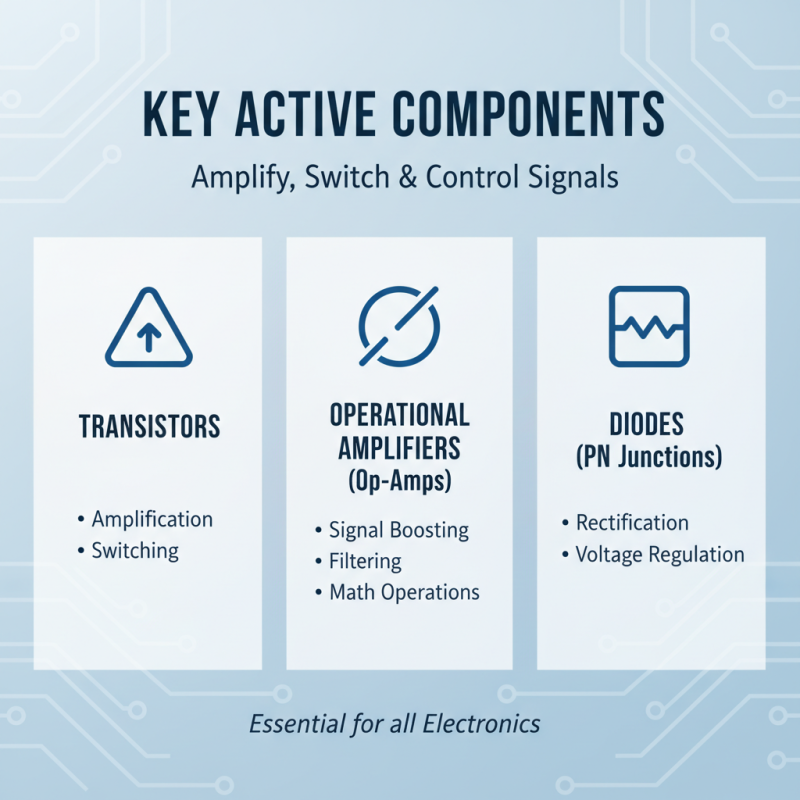
Transistors and diodes are prominent examples of active components. A transistor acts as a switch or an amplifier in circuits. It regulates current flow and adjusts signal levels. Diodes, on the other hand, allow current to flow in one direction only. This characteristic is vital for rectification processes. Their specific functions enable various applications in power supplies and signal processing.
Understanding active components involves recognizing their limitations. For instance, while transistors can amplify signals, they also introduce noise. This noise can degrade performance. Moreover, designing circuits with active components is challenging. The balance between power consumption and efficiency requires careful consideration. Active components play a crucial role in modern electronics, but they demand precise engineering skills.
Key Types of Active Components and Their Functions
Active components play a crucial role in electronic devices. They can amplify, switch, and control signals. Understanding their types helps us use them effectively in various applications.
Transistors are a key type of active component. They control current flow and amplify signals. For instance, in audio equipment, transistors enhance sound quality. They can be found in almost every electronic device today, from radios to computers.
Another important category is operational amplifiers (op-amps). These devices process signals to perform mathematical operations like addition and subtraction. They are widely used in audio processing systems and active filters.
**Tips:** Always consider the required power rating when choosing an active component. Ensure it matches your device specifications to avoid operational failures. Test components under different conditions to assess their performance effectively. Regularly revisiting your designs can reveal areas for improvement.
How Active Components Generate and Control Electrical Signals
Active components play a crucial role in generating and controlling electrical signals. They include transistors, diodes, and integrated circuits. These elements are pivotal in modern electronics. According to a recent report by the International Electrotechnical Commission, the market for active components is forecasted to grow at a CAGR of 8% until 2026. This growth highlights their significance in technological advancement.
Active components function by manipulating current and voltage levels. For instance, transistors can switch signals on and off, controlling the flow of electricity. This switching capability enables the operation of complex circuits and systems. However, designing these components is not without challenges. Engineers must consider factors like heat dissipation and signal integrity, which can compromise performance. Many designs end up requiring multiple revisions before they meet necessary specifications.
Moreover, the reliability of active components is vital. A failure in an active component can lead to circuit malfunctions. A study by the IEEE indicates that more than 30% of hardware failures can be traced back to improper component selection. Ensuring that these components function efficiently under varying conditions is critical. Poor performance can drastically affect the end product. In this fast-paced technology environment, the design process must constantly adapt.
What are Active Components and How Do They Work? - How Active Components Generate and Control Electrical Signals
| Component Type |
Function |
Key Characteristics |
Applications |
| Transistor |
Amplifies and switches electronic signals |
Low power consumption, fast switching |
Computers, radios, and audio devices |
| Operational Amplifier (Op-Amp) |
Used for signal processing and conditioning |
High gain, versatile input and output |
Analog signal amplification, filters |
| Diode |
Allows current flow in one direction |
Low forward voltage drop, rectifying properties |
Rectifiers, signal demodulation |
| Integrated Circuit (IC) |
Combines multiple components into a single package |
Compact, efficient, cost-effective |
Microprocessors, sensors |
| Voltage Regulator |
Maintains a constant voltage level |
Voltage stability, thermal regulation |
Power supplies, battery chargers |
Applications of Active Components in Modern Technology
Active components play a crucial role in modern technology. These are components that require an external power source to operate. Common examples include transistors, diodes, and integrated circuits. They are essential in devices like smartphones and computers, enabling complex functions and computations.
Applications of active components span various fields. In telecommunications, they manage signals. They amplify and process information, making communication clearer and faster. In healthcare, these components monitor vital signs and manage medical devices. Their reliability is often questioned, leading to system failures at times.
Tips: Focus on the power source. Understanding this can clarify your grasp of active components. Also, consider the limitations. Not every application is ideal. Some devices may underperform due to component inefficiencies. Stay open to exploring alternatives for your specific needs.
Applications of Active Components in Modern Technology
Future Trends in Active Components and Their Impact on Innovation
Active components have become crucial in various technologies, driving innovation across multiple fields. As industries increasingly rely on smart devices and automation, these components play a key role. They not only enhance performance but also enable intelligent decision-making in real time.
Future trends indicate that active components will continue to evolve. Advances in materials and designs could lead to more efficient and powerful devices. However, this rapid pace also presents challenges. Companies may struggle to keep up with the latest developments. It raises questions about sustainability. Will these innovations contribute to more electronic waste?
Moreover, the integration of artificial intelligence with active components is another area of focus. This combination will likely drive significant breakthroughs. Yet, it poses ethical dilemmas. Issues like data privacy and security become more prominent. Creators must reflect on the implications of their inventions. Balancing innovation with responsibility is essential for meaningful progress.